
This content is promotional.
The mAbXmise quantification kits are intended to monitor the concentration of therapeutic monoclonal antibodies (mAbs) in samples from patients treated with these mAbs. The kit is a quantitative assay. The test can be performed on plasma (EDTA, heparin or citrate collection tubes) and serum. Assay results are intended to be used by healthcare professionals. Before use, it is important to carefully read the instructions provided with the product.
This space contains information on medical devices, the use of which is reserved for healthcare professionals. In application of the law of December 29, 2011 relating to the strengthening of health security, I certify that I am a health professional and therefore be authorized to access this information.
mAbXmise monoclonal antibodies quantification kits are In Vitro Diagnostic Medical Devices for laboratory professional use and CE-IVD labeled for Europe by BSI. Assay results are intended to be used by healthcare professionals. The kits are designed to perform absolute quantification by LC-MS (Liquid Chromatography – Mass spectrometry) of specific therapeutic monoclonal antibodies (mAbs) in a patient sample. Assay results are intended to be used by healthcare professionals. Before use, it is important to carefully read the instructions provided with the product. The products are non-refundable. The mAbXmise Kit described has not been cleared by any regulatory entity for diagnostic purposes outside of Europe. Proteomics mAbXmise Kits are not available for sale in all countries.
I am a healthcare professional
Close window if you are not a healthcare professional
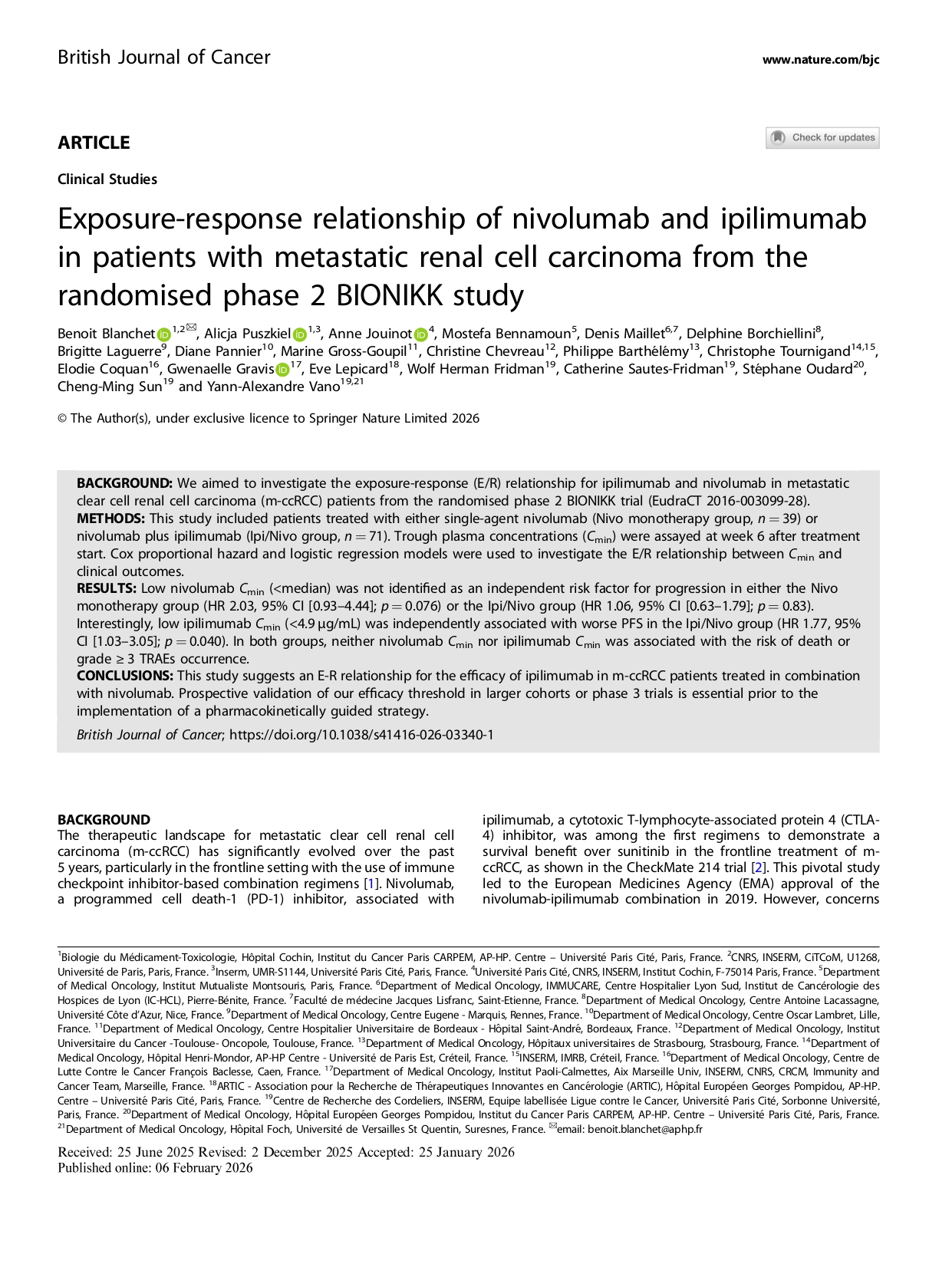
In this study, the authors aimed to investigate the exposure-response (E/R) relationship for ipilimumab and nivolumab in patients with metastatic clear cell renal cell carcinoma (m-ccRCC). A total of 110 patients from the BIONIKK cohort were included.
Two patient groups were analyzed: one received nivolumab monotherapy, while the other received combination therapy with nivolumab and ipilimumab. Drug concentrations were assessed at week 6 using mAbXmise OTDM1 kits in combination with LC-MS/MS. Nivolumab concentrations ranged from 1.0 to 96.7 μg/mL, with a median Cmin of 56.5 μg/mL in the monotherapy group and 30.7 μg/mL in the combination therapy group. In the latter group, ipilimumab concentrations ranged from 1.0 to 22.5 μg/mL.
The authors suggest that an exposure-response relationship may exist for ipilimumab efficacy in m-ccRCC patients treated with the combination regimen. Specifically, a lower ipilimumab Cmin <4.9 μg/mL at week 6 may be associated with shorter progression-free survival (PFS). As the results are exploratory, prospective validation of the efficacy threshold in larger studies or phase 3 trials is essential before implementing a pharmacokinetically guided strategy.